
Fiction Review: Isaac Asimov’s 1954 Classic, “The Caves of Steel”
The Master of Science Fiction, Isaac Asimov, is known by most as just that, a Sci-Fi writer. However, this first novel in Asimov’s groundbreaking Robot series also defined the crossover sub-genre of Mystery Science Fiction. “The Caves of Steel” has the proper mix of villains, chases, clue-dropping, and misdirection, along with a hardened detective trying to find justice while also contemplating what justice is. What is different is the story takes place in a sprawling future vision of New York City, where the masses live their entire lives under giant metal and concrete domes, living on yeast extract, and bustling around on highspeed sidewalks. As expected, there is also a sidekick to explain things to and to be a source of conflict for our hero. The difference is that this sidekick is R. Daneel Olivaw. R stands for robot, and he is much more than your typical Dr. Watson.

A Death in Spacetown
The story opens three thousand years in the future after humanity has overpopulated the earth. In response, we have moved to colonize the stars and concentrated the population that stayed behind into massive enclosed cities. The off-worlders, called Spacers, have created a very different society where advanced technology and extreme personal wealth are supported by legions of robots and other advanced technologies. Earth dwellers continue to live a crowded, noisy, and occasionally discontent existence. The conflict between these two ways of life is the tension that leads to the murder of a prominent spacer and gives our very human detective, Elijah Baley, a mystery to solve.
One of the Spacer’s leading experts in robotics is found dead, the center of his body destroyed by a blaster round to the torso. Baley is brought on to the case by his college friend who has risen to police commissioner, Julius Enderby. The Spacers want to be part of the investigation, and they send one of their most advanced robots, R. Daneel Olivaw, to partner, and live with Baley. Olivaw was created by the murdered man and looks just like his creator. Two questions remain unanswered. How did the killer get into the tightly controlled Spacetown, and how did they get the murder weapon in and out?
After meeting Olivaw, Baley takes him home to spend the night at his apartment. On the way, they encounter a near riot outside a shoe store. The clerks have been replaced by robots, and the locals are unhappy. Olivaw pulls a blaster on the crowd to gain control, threatening to shoot them. Once home, we learn more about life in Earth’s giant cities as Baley explains things to Olivaw.
— Warning – Beyond Here be Spoilers —
In the morning, they visit Spacetown, and Baley accuses Olivaw of the murder. The only logical solution he sees is that Olivaw is actually not a robot. He is the human researcher, and some other body was used as a distraction. Olivaw shows that he is indeed mechanical, and Baley leaves defeated.
The new partners investigate the murder further, and we learn more about Spacer and Earth society, and about the Medievalist factions who are not fond of robots. During lunch, some of the men behind the shoe store encounter show up and act suspiciously. When they leave the kitchen, the men give chase, and the detective shows his new robot partner how to race across the moving walkways of the City.
After consulting with a robotics expert, Baley thinks he has solved the mystery and accuses Olivaw of being the murderer, having stored the weapon inside his false stomach. Olivaw and the expert explain how that could never have happened and show that Olivaw’s blaster has never been fired. Soon after, Baley’s wife shows up and confesses that she is part of the conspiracy group and identifies a man named Clousar as one of the leaders, and Olivaw identifies him as one of the people who chased them.
Important to the Sci-Fi plot, Baley seeds the idea of emigration with Clousar, which is the goal of the spacers. Once that is done, the Spacers decide it is time to leave Earth to its own devices. Baley prepares to interrogate Clousar, but the artificial brain of the police department robot, R. Sammy, was scrambled, and someone has framed Baley for the crime. He has just a few hours to prove his innocence before the Spacers and Olivaw leave.
Going on a hunch, he gets a copy of video footage of the original murder scene and finds the clue that proves his theory. He accuses the commissioner of the murder. Baley had deduced that the Enderby had gone to Spacetown to destroy the robot Olivaw. But he accidentally broke the antiquated glasses he wore and, unable to tell the difference, killed Olivaw’s creator by mistake. After gaining a confession, they convert the commissioner to be an evangelist for the Galactic colonization effort in exchange for not bringing charges against him.
The experience changes Baley and Olivaw, and they leave the police station arm and arm.
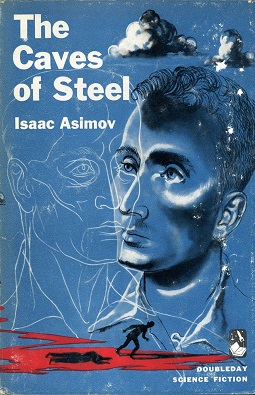
A Classic That Stands Up Over Almost Seventy Years
This book was an emotional read for me because it was my first serious Sci-Fi book. A few days after my father was transferred to an Air Force base in Turkey, a neighbor helping us settle in noticed me reading my mom’s collection of Agatha Christie paperbacks and brought over a paperback copy of The Caves of Steel, saying, “If you like mysteries, you will love this.” I was hooked. I ended up devouring every Asimov book I could get and kept reading Sci-Fi to this day.
Your Pulp Roots are Showing
Rereading it now, the mystery story itself is actually not that well done. Our detective, Elijah Baley, is more of a family man than a hard-boiled gumshoe or genius master of deduction. He comes to his conclusions more by picking the most obvious option than by digging deep into human nature or scientific evidence. The bulk of the story deals with life on Earth in three thousand years, how society works, and the pressure that an ever-increasing population puts on humanity both on the home planet and in the stars.
From a more critical perspective, it is basic writing, and Asimov is definitely a tell, don’t show writer. But I like the whole package. It was easy to get into the story, follow it, and focus on the message behind what was being shared and the implications for future novels in both the Robot and Foundation/Empire series. Mabe, it also brought me back to when I devoured the loaned book on our coach in a new, strange country at an awkward and strange time when I had not made new friends. Back then, contemplating living on yeast-based food and racing across the strips in New York City with a detective and a robot was just what I needed.
Baley and Olivaw are really the only characters that Asimov fully brings to life. A master of the short story, he never gives the details on these two. But we get to know them somewhat through their interaction. The other characters provide platforms for dialog, potential suspects, or icons for various portions of the imagined future society.
The differences between the two main characters and the bridge-building they attempt throughout the novel are shown most in a short bit of dialog about curiosity and the job of a detective.
Baley asks, “Have you no personal curiosity, Daneel? You’ve called yourself a detective. Do you know what that implies? Do you understand that an investigation is more than a job of work? It is a challenge. Your mind is pitted against that of the criminal. It is a clash of intellect. Can you abandon the battle and admit defeat?”
And the robot responds:
“If no worthy end is served by a continuation, certainly” (232-233).
At the end of the novel, after getting a confession from the killer, “Baley, suddenly smiling, took R. Daneel’s elbow, and they walked out the door, arm in arm” (256). This shows the connection has been made, and the two are prepared to solve more crimes in Earth’s future.
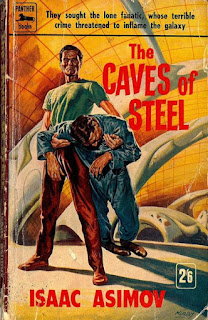
Solving a Mystery While Changing the Direction of Humanity
As a hybrid Sci-Fi – Mystery novel, the book presents three problems to be solved. The obvious is who murdered the Spacer and then R. Sammy. The second is how humanity can continue to grow its population. And the third is what is the proper relationship between biological and artificial life. Asimov solves these three problems at the same time by identifying the commissioner as the killer, but then using his confession to essentially blackmail him into being an advocate for the overpopulation on Earth to go and colonize more stars. This conclusion teaches Baley and Olivaw that the proper relationship between humans and robots is a partnership.
This simple encounter and the introduction of Galactic Colonization into the psyche of Earthbound humans sets the path of history forward that Asimov will explore in multiple future novels. Along with the original Foundation trilogy, which was published a few years earlier, It also starts in motion a fictional universe that will be distorted to the level of being unwatchable in the Apple TV series Foundation.
An Enjoyable and Meaningful Read
If I could change anything about the book, it would be to make the mystery part a bit more mysterious. Asimov foreshadows the answer to the mystery way too obviously when the commissioner is constantly fumbling with his new glass. He needs glasses to see, and guess what? He lost his glasses around the time of the murder, he was in Spacetown around the time of the murder, and the robot looks like the human that was killed.
This is a novel I would strongly recommend, especially to a young aficionado of Science Fiction. It is a classic that defines and establishes so much that will come after it. And it is a decent partner and detective story. Although not a literary masterpiece, it is a deep read in that the societal and technological questions it brings up are still issues today. The recent introduction to the public of Generative AI moves the question of what artificial intelligence is and how it can be used to help or replace humanity is no longer speculation.
—
Asimov, Isaac. The Caves of Steel (The Robot Series Book 1) (p. 256). Random House Worlds. Kindle Edition.
Did you enjoy this review? Please leave a comment or visit my writing blog.

 Berkeley Mystery Fiction